06.08.2026 11:25
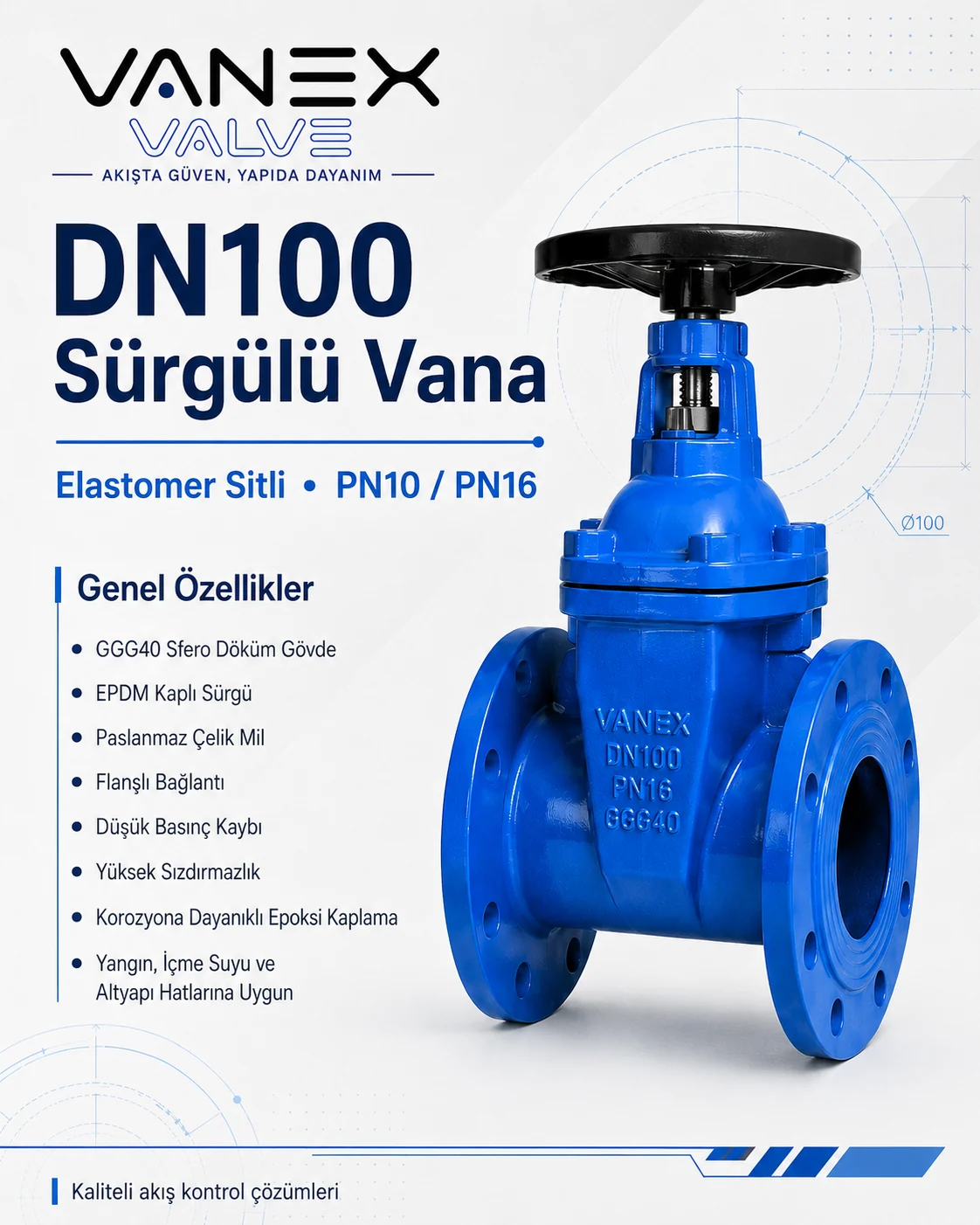
A VANEX gate valve is an industrial flow-control device designed to fully open or completely shut off the flow of liquid or gas in a pipeline. The gate inside the valve moves vertically through a stem mechanism. When the gate is raised, the flow passage opens. When the gate is lowered, the passage closes.
Gate valves are primarily used for pipeline isolation. They are not designed for precise throttling or continuous flow regulation. For optimum performance, the valve should be operated in either the fully open or fully closed position.
How Does a VANEX Gate Valve Work?
The operating principle of a VANEX gate valve is based on the movement of the gate perpendicular to the direction of flow. When the handwheel is turned counterclockwise, the stem mechanism raises the gate. As the gate moves upward, the flow passage opens and the fluid begins to pass through the valve.
When the handwheel is turned clockwise, the stem moves the gate downward. Once the gate is fully seated against the sealing surfaces or resilient seat, the flow is stopped and the pipeline is isolated.
Opening Operation
During opening, the rotary movement of the handwheel is converted into linear movement through the valve stem. As the stem rises, the gate is withdrawn from the flow passage. When the valve reaches the fully open position, the gate is positioned outside the main flow path.
In this position:
The fluid passes through a wide and uninterrupted passage.
Pressure loss remains low.
Turbulence is reduced.
Pipeline flow capacity is maintained.
Energy demand on pumps and the system is reduced.
A fully open gate valve provides flow characteristics similar to those of a straight section of pipe.
Closing Operation
To close the valve, the handwheel is turned clockwise. The stem mechanism lowers the gate into the flow passage. The passage gradually becomes narrower until the gate contacts the sealing surface and completely stops the flow.
In resilient-seated models, the elastomer coating on the gate is compressed against the valve body seat. This design provides low operating torque, reliable sealing and long service life.
The valve should not be closed too quickly. Rapid closure may cause pressure surges known as water hammer. Gate valves should therefore be closed gradually and in a controlled manner.
Function of the Gate
The gate is the main moving component that opens or closes the flow passage. It moves perpendicular to the direction of flow and completely blocks the passage when the valve is closed.
Common gate designs include:
Resilient-coated gate
Metal-seated gate
Wedge gate
Parallel gate
Solid or split gate
VANEX gate valves are designed with a suitable gate and sealing configuration according to application requirements.
Stem and Handwheel Mechanism
The handwheel is the component used by the operator to open or close the valve. The rotary force applied to the handwheel is transmitted to the gate through the stem.
There are two main stem designs:
Rising Stem Gate Valve
In a rising stem gate valve, the stem moves upward or downward as the handwheel is operated. The visible stem position provides a clear indication of whether the valve is open or closed. This design is commonly used in fire-protection systems, industrial plants and applications where visual position indication is required.
Non-Rising Stem Gate Valve
In a non-rising stem gate valve, the stem rotates inside the valve body and moves the gate without extending outward. This design is advantageous where installation space is limited. It is widely used in underground pipelines, water networks and confined areas.
Sealing Principle
Sealing is achieved when the gate makes full contact with the seating surfaces inside the valve body. In resilient-seated valves, the elastomer coating compensates for minor surface irregularities and provides reliable shut-off.
Sealing performance depends on:
Compatibility between the gate and seat
Quality of the elastomer material
Correct stem alignment
Applied closing torque
Fluid pressure and temperature
Presence of foreign particles
Correct installation
Excessive force should not be applied while closing the valve. Excessive torque may damage the stem, gate, sealing elements and seating surfaces.
Why Should a Gate Valve Be Fully Open or Fully Closed?
Gate valves are designed for isolation, not for throttling. If the valve remains partially open for long periods, high-velocity fluid directly impacts the gate and seating surfaces.
This may cause:
Gate surface erosion
Vibration and noise
Cavitation
Damage to sealing surfaces
Increased pressure loss
Reduced valve service life
For this reason, VANEX gate valves should normally be used in the fully open or fully closed position.
Flow Direction
Most standard gate valves are suitable for bidirectional flow. The fluid may therefore enter the valve from either direction. However, special designs may require a specific flow direction.
Before installation, the direction markings, technical documentation and operating conditions should be checked.
Pressure Loss and Flow Performance
When a VANEX gate valve is fully open, the gate is positioned outside the flow passage. The fluid therefore encounters minimal obstruction inside the valve.
This provides:
Low pressure loss
High flow capacity
Reduced energy consumption
Improved pump efficiency
Stable pipeline flow
These features make gate valves suitable for long-distance water lines, pumping systems and large-diameter pipelines.
Applications
VANEX gate valves can be used in:
Drinking-water networks
Wastewater pipelines
Water-treatment plants
Fire-protection systems
Irrigation systems
Pumping stations
Industrial pipelines
Heating and cooling systems
Power plants
Municipal infrastructure
Storage and distribution systems
Process plants
Valve selection should consider the fluid type, temperature, operating pressure, nominal diameter, connection standard and environmental conditions.
Operating Recommendations
For reliable and long-term operation:
Use the valve fully open or fully closed.
Open and close the valve gradually.
Do not strike the handwheel.
Avoid excessive closing torque.
Remove foreign particles from the pipeline.
Tighten flange bolts evenly.
Do not expose the valve to pipe stress.
Perform periodic opening and closing tests.
Inspect the stem, packing and sealing areas regularly.
Operate valves that remain unused for long periods at regular intervals.
Conclusion
The VANEX gate valve is a reliable isolation valve that operates through the vertical movement of a gate perpendicular to the flow direction. It provides low pressure loss when fully open and securely stops pipeline flow when fully closed.
When correctly selected, installed and maintained, VANEX gate valves provide long-lasting, safe and efficient flow-control solutions for water, fire-protection, infrastructure and industrial systems.