17.10.2026 06:22
Ball, gate and butterfly valves are the main industrial valve types. Strainers and hydrants complete the line; the right type depends on fluid and pressure.
In this guide we explain how each valve type works, why it is preferred in each sector and which technical values to check when selecting one, using Vanex Valve products as examples. The aim is to give a fast and correct answer to the question "which valve belongs on this line?" when you prepare a project list or a maintenance plan.
The basic difference between valve types
What separates valve types is the part that stops the flow, the closing element. It determines how the valve opens and closes, how much space it takes and which job it suits.
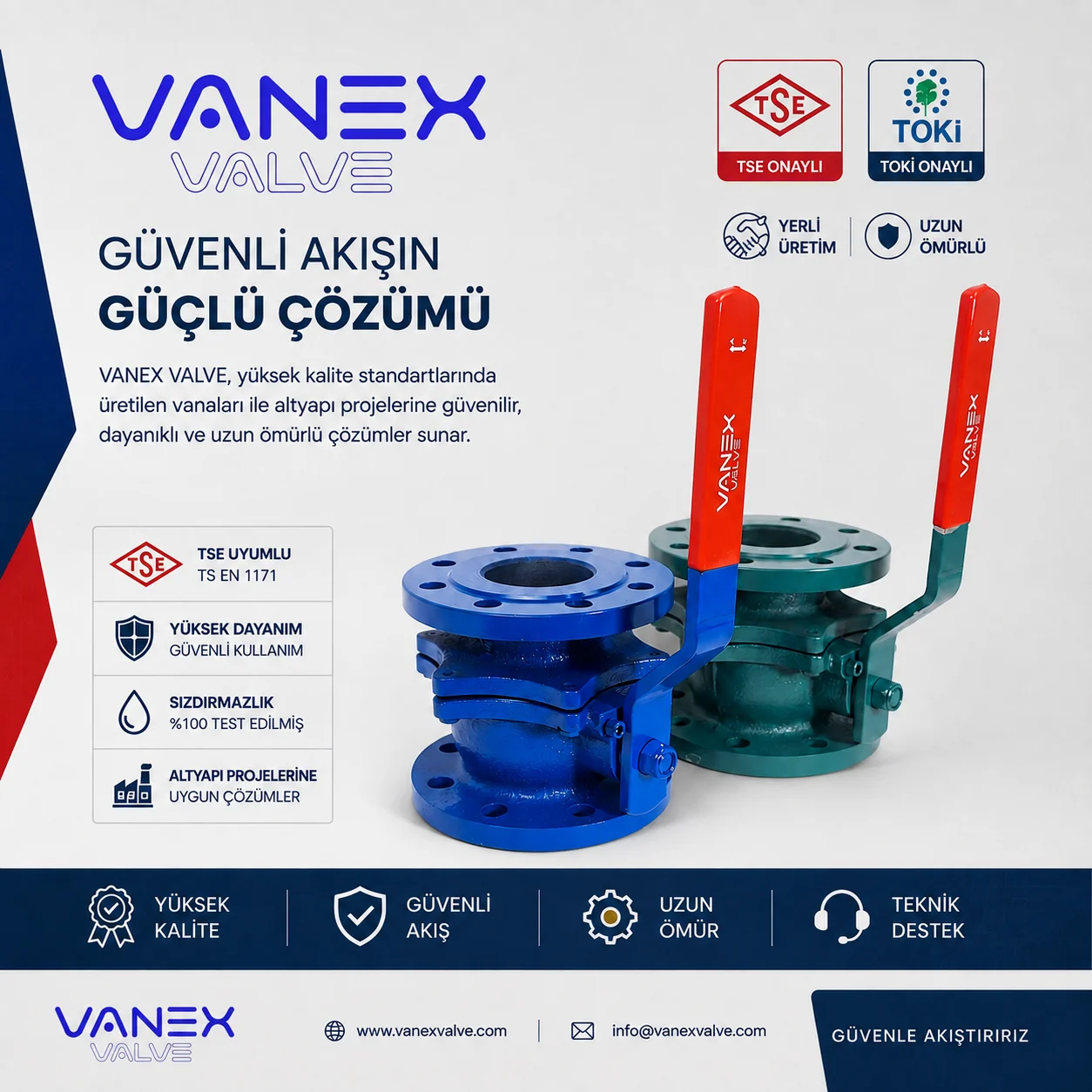
A ball valve has a sphere with a bore through its centre. When the lever is turned a quarter turn (90 degrees), the bore lines up with the flow and the line opens; turning it back closes it.
In a gate valve, a gate moving up and down cuts the flow. The handwheel is turned several times to open or close it; when fully open, almost nothing stands in the flow path.
A butterfly valve has a disc that rotates on its own axis inside the pipe. It works with a quarter turn and takes little space because its body is short.
A strainer is not a shut-off valve; it holds sediment and foreign particles in its screen and protects the valves, pumps and meters behind it.
A fire hydrant is the outlet of the fire water network and gives the fire brigade quick access to water.
1. Ball valve: fast shut-off and low pressure loss
The ball valve is one of the most widely used valve types in industry. Because it opens and closes fully with a quarter turn, it is practical where emergency shut-off is needed. In full bore models the bore of the ball is close to the pipe bore, so the flow is not narrowed and pressure loss stays at its lowest level.
The body and cover of the Vanex PN 10-16 Full Bore Flanged Ball Valve are GG-25 cast iron, the sealing element is PTFE and the maximum operating temperature is 180 °C. It is produced in sizes from DN 25 to DN 250. It is used in heating and cooling systems, low pressure steam lines, fluids that do not contain acid or alkali, chemical and paper plants, field irrigation lines and industrial oil and paint plants.
Gas lines are a separate class. The body and cover of the Vanex PN 16-25 Natural Gas Ball Valve are GGG-40 ductile iron; it is Gazmer approved and compliant with TS 9809. It is designed for pressurised gases, liquid fuels, natural gas and LPG systems, with a maximum operating temperature of 60 °C. For gas lines with limited installation space there is also the PN 16-25 Short Pattern Natural Gas Ball Valve with the same properties.
2. Gate valve: full opening and full closing on water and wastewater lines
A gate valve is designed for lines where the flow must be either fully open or fully closed. When fully open it gives low pressure loss. Using it half open to regulate flow is not recommended, because the gate stays in the stream and the sealing surface wears. Where flow regulation is needed, a butterfly valve is the better option.
The Vanex Resilient Seated Gate Valve is used in water, wastewater, irrigation, fire and industrial installations. Its elastomer coated gate gives high tightness, it suits flow in both directions and its operating torque is low. It has flanged connections and an epoxy coated, corrosion resistant body, and it can be operated manually or with an actuator.
The Vanex Rising Stem Gate Valve (OS&Y) does the same job, and in addition you can tell from outside whether the valve is open or closed by looking at the position of the stem. This makes daily operation easier on fire lines and large plant distribution lines where valve position should be checked at a glance.
3. Butterfly valve: compact build and flow control
A butterfly valve has a much shorter face-to-face length than a gate valve of the same size. That is why it stands out in tight spaces such as pump stations, plant rooms and service shafts. Because the disc turns a quarter turn, it can be used both for shut-off and for flow control.
The Vanex Wafer Type Butterfly Valve (Cast Body) is offered in PN 6, PN 10 and PN 16 pressure classes. The cast body gives mechanical strength, and the short installation length lets it fit easily between two flanges. It is used in drinking and service water installations, fire extinguishing systems, HVAC and air conditioning lines, irrigation and agricultural applications, wastewater and treatment plants, industrial process lines, pump and mechanical installation systems, and storage and distribution lines.
4. Strainer: the part that protects the valve and the pump
Sand, welding slag or rust particles carried in the line damage the sealing surfaces of valves and pump impellers. A Y type strainer holds these particles in its stainless steel screen and is installed in front of the equipment to be protected.
The body and cover of the Vanex PN16 Y Type Flanged Strainer are GG-25 cast iron, the screen is AISI 304 stainless steel and the maximum operating temperature is 180 °C. It is used in steam and compressed air systems, hot and cold water lines, and gas, oil and chemical fluid systems. Cleaning the screen at regular intervals prevents pressure loss on the line from increasing.
5. Fire hydrant and its connection parts
Fire installations are the area where valve selection is checked most strictly. The Vanex PN16 DN80 and DN100 Above-Ground Fire Hydrant is used in municipal water networks, industrial plants, warehouses, logistics areas, mass housing projects and fire safety lines. It is epoxy coated against corrosion and installed with a flanged connection.
The hydrant is connected to the underground water line with a Hydrant Elbow (duckfoot bend). The Vanex hydrant elbow is GGG40 (EN-GJS-400-15) ductile iron, its flanges comply with TS EN 1092-2, its gasket is EPDM rubber and it turns the water flow by 90 degrees. To open and close the hydrant, a metal bodied Hydrant Wrench designed for high torque is used.
Which valve is used in which sector?
Water networks, wastewater and treatment plants: Resilient Seated Gate Valve, Wafer Type Butterfly Valve.
Natural gas and LPG lines: PN 16-25 Natural Gas Ball Valve or Short Pattern Natural Gas Ball Valve.
Heating, cooling and low pressure steam lines: PN 10-16 Full Bore Flanged Ball Valve with a Y Type Strainer in front.
HVAC and air conditioning: Wafer Type Butterfly Valve.
Chemical, paper, oil and paint plants: Full Bore Flanged Ball Valve for fluids that do not contain acid or alkali.
Fire installations: Rising Stem Gate Valve (OS&Y), Above-Ground Fire Hydrant, Hydrant Elbow and Hydrant Wrench.
Agricultural irrigation: Full Bore Ball Valve, Resilient Seated Gate Valve or Butterfly Valve.
6 values to check when selecting a valve
1. Fluid: water, gas, steam, oil or chemical. Approved gas valves are used on gas lines.
2. Temperature: for example, the limit is 60 °C for the natural gas ball valve and 180 °C for the full bore flanged ball valve.
3. Pressure class (PN): PN16 means a nominal pressure of about 16 bar. The operating pressure of the line must not exceed the class of the valve.
4. Nominal size (DN): the valve size is chosen the same as the pipe size.
5. Connection type and flange standard: on flanged valves, the standard and bolt pattern of the mating flange must match.
6. Operation: only shut-off, or flow regulation as well; manual operation or an actuator.
Three common mistakes
Leaving a gate valve half open to regulate flow wears the gate and the sealing surface. Using a water valve on a gas line is risky for both safety and inspection. Not fitting a strainer in front of pumps and meters is one of the most common reasons valves fail early.
Dimension tables, material lists and technical drawings of Vanex products are on each model's own page under Products. To read more on the subject, see the blog posts on ball valve types, gate valve types, butterfly valve types and PN10, PN16, PN25 and PN40 classes. If you would like to choose the right model for your project together with us, you can reach us through the form on the Contact page.