15.07.2026 16:00
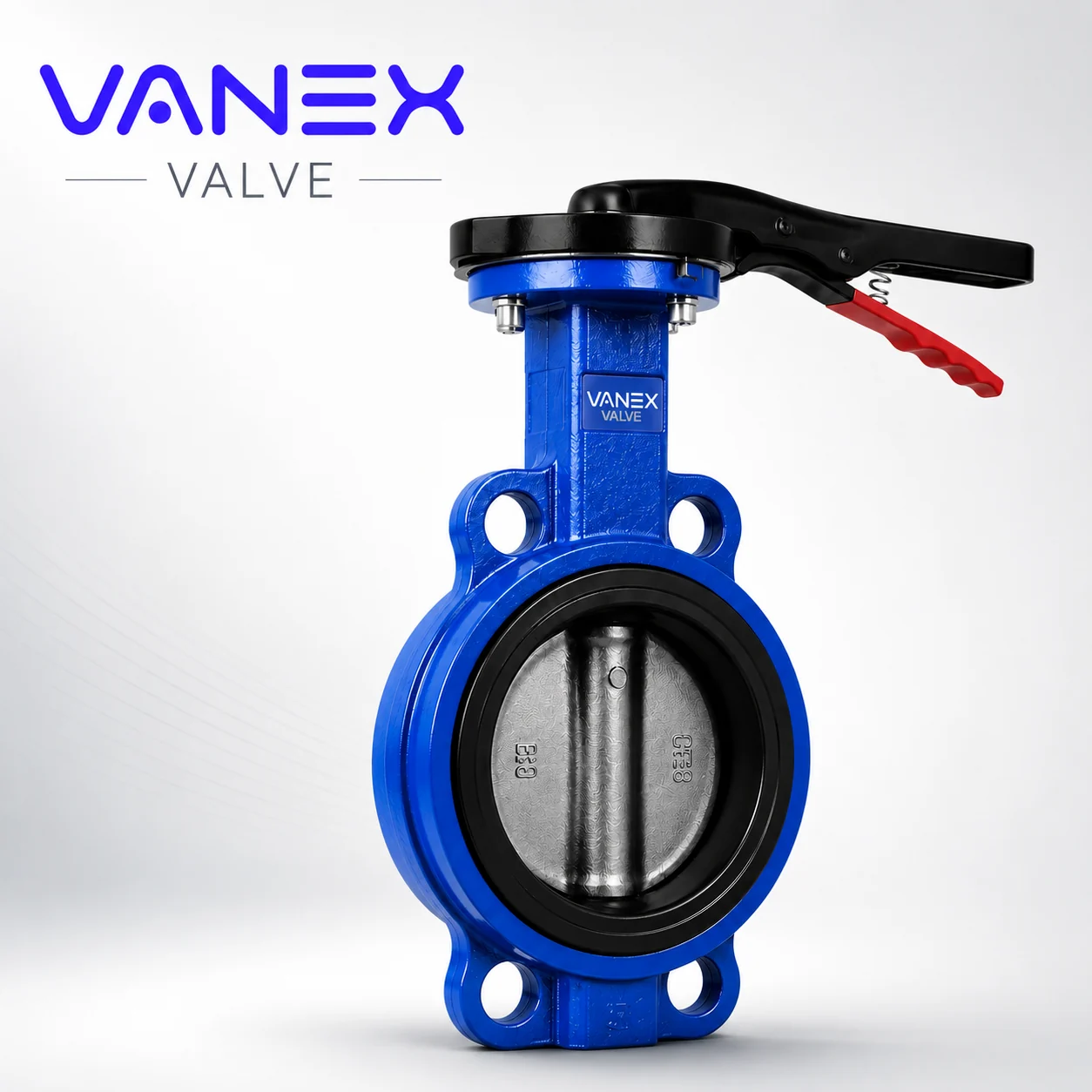
A butterfly valve is a quarter-turn valve used to open, close or regulate the flow of liquids, gases and certain semi-fluid materials in pipelines. Flow control is achieved by rotating a circular disc mounted inside the valve body through approximately 90 degrees around its shaft.
Thanks to its compact structure, low weight, fast operation and cost-effective design, butterfly valves are widely used in applications ranging from water installations and fire protection systems to industrial production lines and power plants.
How Does a Butterfly Valve Work?
The operating principle of a butterfly valve is simple. The disc inside the valve is connected to the shaft. When the handle, gearbox or actuator rotates the shaft, the disc also rotates around its own axis.
When the disc is parallel to the pipeline, the valve is fully open.
When the disc is perpendicular to the pipeline, the valve is fully closed.
When the disc is positioned between the open and closed positions, the flow rate can be regulated to a certain extent.
Butterfly valves generally move from the fully open position to the fully closed position with a 90-degree rotation. For this reason, they are classified as quarter-turn valves, just like ball valves.
Main Components of a Butterfly Valve
1. Valve Body
The valve body is the main structure that supports all the components of the butterfly valve. The body material is selected according to the operating conditions and application.
Common body materials include:
Cast iron
Ductile iron
Carbon steel
Stainless steel
Aluminium alloys
Engineering plastics
2. Disc
The disc is the circular component that opens, closes or regulates the flow inside the pipeline. Because it is in direct contact with the process fluid, correct material selection is extremely important.
Common disc materials include:
Ductile iron
Stainless steel
Nickel-plated cast iron
Aluminium bronze
Special alloys
3. Shaft
The shaft transfers the rotational force from the operating mechanism to the disc. It is generally manufactured from stainless steel or high-strength alloy steel.
4. Seat or Sealing Liner
The seat provides sealing between the disc and the valve body. It may be manufactured from elastomeric, polymeric or metallic materials.
Common seat materials include:
EPDM
NBR
FKM/Viton
PTFE
Silicone
Metal sealing surfaces
The seat material must be compatible with the fluid, operating temperature, pressure and chemical conditions.
5. Operating Mechanism
The operating mechanism is used to open and close the valve. Different operating options are available depending on the valve diameter and system requirements:
Manual lever
Worm gearbox
Electric actuator
Pneumatic actuator
Hydraulic actuator
Types of Butterfly Valves
Wafer-Type Butterfly Valve
A wafer-type butterfly valve is installed between two pipe flanges and secured by bolts or studs. It has a compact, lightweight and economical structure.
Wafer-type butterfly valves are commonly used in:
Water installations
Fire protection lines
HVAC systems
Industrial water applications
Lug-Type Butterfly Valve
A lug-type butterfly valve has threaded lugs around the valve body. Each side of the valve can be bolted separately to the pipe flanges.
This design allows one side of the pipeline to be removed while the other side remains isolated. It is especially useful in systems that require frequent maintenance or line separation.
Flanged Butterfly Valve
A flanged butterfly valve has integral flanges on the valve body. It is generally used in large-diameter pipelines and applications requiring strong mechanical connections.
Double-Flanged Butterfly Valve
A double-flanged butterfly valve has full flanges on both sides of the valve body. It is widely used in:
Large water transmission pipelines
Water treatment plants
Pumping stations
Municipal infrastructure systems
Concentric Butterfly Valve
In a concentric butterfly valve, the shaft passes through the centre of the disc, and the disc remains in continuous contact with the seat.
This design is commonly used in low- and medium-pressure applications.
Double-Offset Butterfly Valve
In a double-offset butterfly valve, the shaft and disc centres are offset from each other. This allows the disc to move away from the seat more quickly during opening.
As a result:
Friction is reduced.
Seat wear is minimised.
Operating torque is lowered.
Service life is extended.
Triple-Offset Butterfly Valve
A triple-offset butterfly valve is designed for high-temperature and high-pressure applications. It generally uses a metal-to-metal sealing system.
Typical application areas include:
Steam systems
Hot gas lines
Oil and gas facilities
Refineries
Power plants
Heavy industrial processes
Butterfly Valve Sealing Types
Soft-Seated Butterfly Valves
Soft-seated butterfly valves use elastomeric or polymeric materials such as EPDM, NBR, FKM or PTFE.
Advantages include:
High sealing performance
Low operating torque
Cost-effective construction
Easy maintenance
Reliable shut-off in low- and medium-pressure systems
Metal-Seated Butterfly Valves
Metal-seated butterfly valves use metallic sealing surfaces between the disc and seat.
They are preferred in applications involving:
High temperatures
High pressures
Abrasive fluids
Steam
Hot gases
Heavy-duty industrial processes
Metal-seated valves can withstand more demanding operating conditions than standard elastomer-seated valves.
Where Are Butterfly Valves Used?
Butterfly valves are used in a wide range of industrial and commercial applications.
Main application areas include:
Drinking water systems
Wastewater systems
Water treatment plants
Fire protection systems
Heating and cooling systems
HVAC installations
Pumping stations
Agricultural irrigation systems
Marine and shipbuilding applications
Chemical plants
Food processing lines
Pharmaceutical facilities
Power plants
Oil and gas facilities
Compressed-air lines
Mining plants
Cement plants
However, the body, disc, shaft and seat materials must be compatible with the process fluid. Not every butterfly valve is suitable for chemicals, high-temperature fluids or abrasive media.
Advantages of Butterfly Valves
The main advantages of butterfly valves are:
Compact and lightweight design
Low space requirement
Easy installation and removal
Economical solution for large diameters
Fast opening and closing with quarter-turn operation
Manual or automated operation
Low maintenance requirements
Efficient performance in low- and medium-pressure systems
Compatibility with electric and pneumatic actuators
Possibility of limited flow regulation
Lower weight compared with many other valve types
Disadvantages of Butterfly Valves
Butterfly valves also have certain limitations:
The disc remains inside the flow path even when the valve is fully open.
The disc may create a certain amount of pressure loss.
Standard butterfly valves are not always suitable for highly accurate flow control.
Incorrect seat selection may cause leakage.
Cavitation and excessive flow velocity may damage the disc and seat.
Standard elastomer-seated models are unsuitable for very high temperatures.
Special designs may be required for very high-pressure systems.
Difference Between Butterfly Valves and Ball Valves
Both valve types operate with a quarter-turn movement, but their internal structures and applications are different.
A butterfly valve controls flow with a rotating disc. A ball valve controls flow with a spherical closure element containing a bore.
Butterfly Valve
Lighter in weight
More economical in large diameters
Requires less installation space
Disc remains in the flow path
Widely used in large water pipelines
Ball Valve
Generally provides higher sealing performance
Full-bore models create very low pressure loss
Widely used in small- and medium-diameter pipelines
Suitable models are available for higher pressures
Difference Between Butterfly Valves and Gate Valves
A gate valve controls flow with a gate that moves vertically. A butterfly valve uses a rotating disc.
Butterfly Valve
Opens and closes faster
Lighter and more compact
Easier to automate
Requires less installation space
Gate Valve
May provide lower flow resistance when fully open
Mainly used for isolation
Requires more time to open and close
Can be heavier and larger in large diameters
How to Select a Butterfly Valve
Selecting the correct butterfly valve requires more than matching the pipe diameter. Several technical criteria must be evaluated together.
Nominal Diameter
The DN size of the valve must match the nominal diameter of the pipeline.
Common sizes include:
DN50
DN65
DN80
DN100
DN125
DN150
DN200
DN250
DN300
Pressure Rating
The valve pressure rating must be suitable for the maximum operating pressure of the system.
Common pressure ratings include:
PN6
PN10
PN16
PN25
PN40
The selection process must also consider:
Pump discharge pressure
Pressure fluctuations
Water hammer
Start-up pressure
Emergency conditions
Fluid Type
The body, disc, shaft and seat materials must be chemically compatible with the fluid.
Typical fluids include:
Clean water
Wastewater
Seawater
Compressed air
Natural gas
Steam
Oil
Acids
Alkaline fluids
Food products
Chemicals
Operating Temperature
The temperature resistance of the seat and other internal components must be considered.
For example, EPDM is commonly used in water and hot-water applications, but it may not be suitable for petroleum-based fluids.
Connection Type
The valve connection must match the pipeline design.
Available options include:
Wafer type
Lug type
Single-flanged
Double-flanged
Welded
Hygienic connection
Operating Method
The operating method should be selected according to the valve diameter, operating frequency and automation requirements.
Manual lever for small diameters
Gearbox for large diameters
Electric actuator for remote control
Pneumatic actuator for rapid operation
Hydraulic actuator for high-force applications
Sealing Requirement
Where complete isolation is required, the shut-off class and leakage performance must be checked carefully.
Sealing performance is especially important in:
Gas systems
Chemical plants
Process lines
Hazardous fluid applications
Fire protection systems
Butterfly Valve Installation Requirements
Correct installation is essential for reliable and long-lasting operation.
Pipe flanges must be correctly aligned.
The distance between the flanges must be suitable for the valve dimensions.
The disc should be kept slightly open during installation.
The disc must not contact the pipe or flange inner surfaces.
Bolts must be tightened gradually and in a cross pattern.
The valve body must not carry the mechanical load of the pipeline.
Welding operations must be completed before valve installation.
Dirt, welding residue and foreign particles must be removed from the pipeline.
The opening and closing directions must be checked on actuated valves.
The valve must be installed according to the manufacturer’s flow-direction instructions.
In wafer-type butterfly valves, incorrect flange selection or excessive bolt tightening may damage the liner and increase operating torque.
Butterfly Valve Maintenance
Butterfly valves generally require limited maintenance. However, regular inspection helps extend service life.
Recommended maintenance procedures include:
Operating the valve periodically
Inspecting the seat surfaces
Checking for deposits on the disc
Inspecting the shaft and connection elements
Checking the gearbox mechanism
Inspecting actuator connections and limit settings
Monitoring leakage, vibration and abnormal torque
Replacing worn seats, bushes and shaft components
Valves that remain inactive for long periods may develop deposits or adhesion between the disc and seat. Periodic operation is therefore recommended.
Common Causes of Butterfly Valve Failure
Most butterfly valve problems are caused by incorrect selection, installation or operating conditions.
Common causes include:
Using a seat material incompatible with the fluid
Exceeding the maximum pressure
Excessive operating temperature
Misaligned flanges
Uneven bolt tightening
Disc contact with the pipeline
Abrasive particles damaging the seat
Excessive flow velocity
Cavitation
Incorrect actuator torque
Shaft overload
Lack of maintenance
Can a Butterfly Valve Be Used for Flow Control?
Butterfly valves can be used for limited flow regulation in addition to isolation. The flow rate can be adjusted by changing the disc angle.
However, keeping the valve at a very small opening for long periods may cause:
High flow velocity
Turbulence
Noise
Vibration
Cavitation
Disc and seat wear
For highly accurate flow regulation, a dedicated control valve or a butterfly valve with a specially designed control characteristic should be used.
Conclusion
A butterfly valve is one of the most widely used valve types in modern piping systems due to its compact construction, fast operation, low weight and economic advantages in large diameters.
When the correct body, disc, shaft and seat materials are selected, butterfly valves provide safe and long-lasting performance in water, wastewater, fire protection, HVAC, energy, chemical and industrial process applications.
For reliable operation, the pressure rating, operating temperature, fluid properties, connection type, sealing requirements and operating mechanism must be evaluated together. An incorrectly selected or improperly installed butterfly valve may cause leakage, excessive torque, pressure loss and premature wear.