01.08.2026 11:51
Ball valves are quarter-turn valves designed to control the flow of liquids, gases and various industrial media. A perforated ball located inside the valve rotates through 90 degrees to open or close the flow path.
Thanks to their reliable sealing, low pressure loss, compact design and fast operation, ball valves are widely used in water systems, natural gas installations, industrial plants, chemical processes and fire protection systems.
Ball valves can be classified according to their connection type, body construction, bore design, material and actuation method.
1. Threaded Ball Valve
Threaded ball valves are connected to the pipeline using internal or external threaded ends. They are generally preferred in small and medium-sized piping systems.
Typical applications include:
Water installations
Compressed-air systems
Heating and cooling lines
Irrigation systems
Industrial utility lines
Gas installations
Their compact construction enables easy installation and operation.
2. Flanged Ball Valve
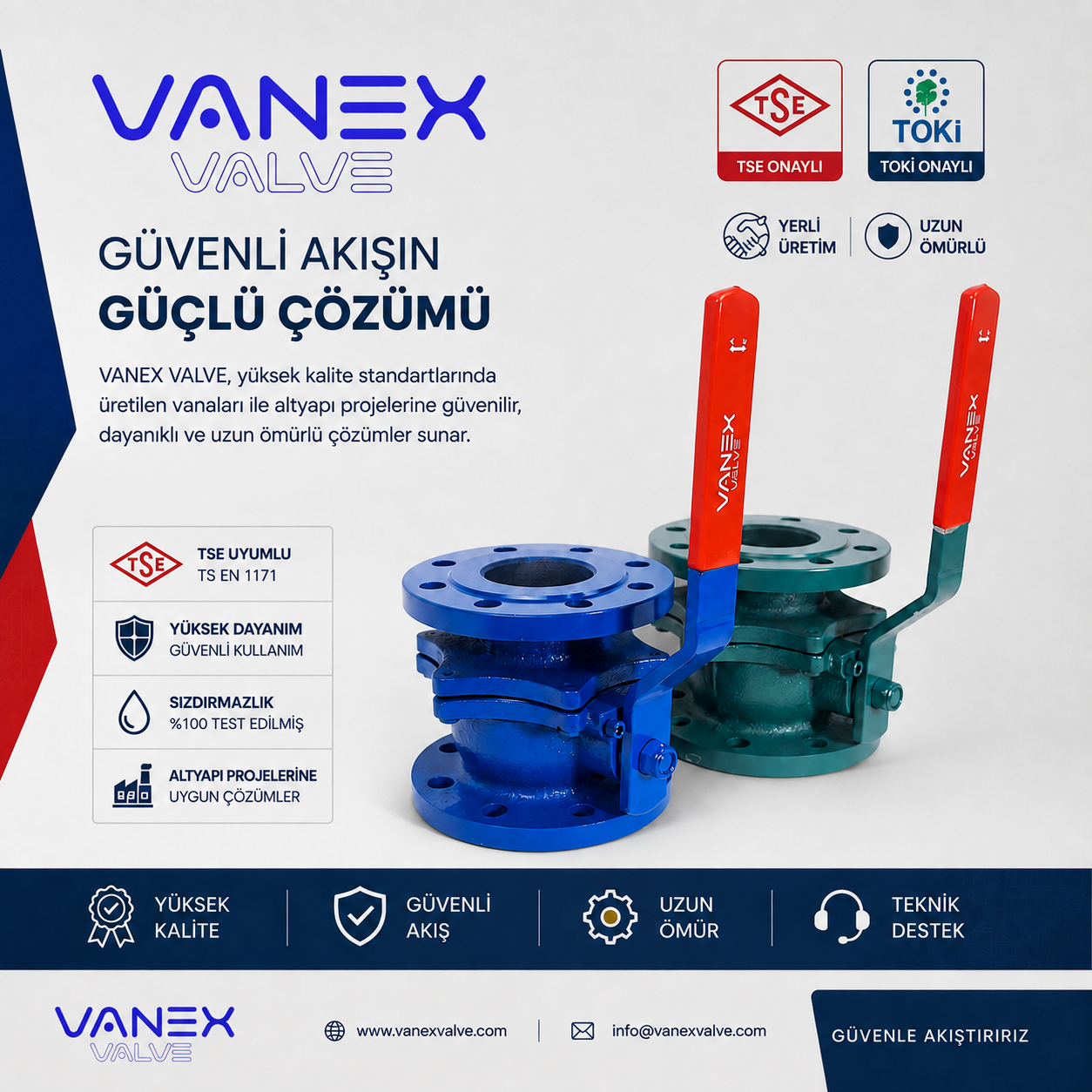
Flanged ball valves are connected between pipeline flanges with bolts and nuts. They are commonly used in larger-diameter and higher-pressure industrial systems.
Typical applications include:
Water treatment plants
Oil and gas facilities
Chemical plants
Power generation facilities
Fire protection systems
Industrial process lines
Flanged connections simplify removal, inspection and maintenance.
3. Full-Bore Ball Valve
In a full-bore ball valve, the opening through the ball is approximately equal to the internal diameter of the connected pipe.
Main advantages include:
Low pressure drop
High flow capacity
Reduced turbulence
Improved energy efficiency
Suitability for pipeline cleaning operations
Full-bore ball valves are ideal for applications where unrestricted flow is important.
4. Reduced-Bore Ball Valve
A reduced-bore ball valve has a smaller internal flow opening than the connected pipeline.
It provides a compact and economical solution for applications where a limited pressure drop is acceptable.
5. One-Piece Ball Valve
One-piece ball valves feature a compact body manufactured as a single main section. They are generally used in small-diameter water, air and utility systems.
6. Two-Piece Ball Valve
Two-piece ball valves consist of two main body sections. They offer easier maintenance than one-piece designs and are widely used in general industrial applications.
7. Three-Piece Ball Valve
Three-piece ball valves include a central body section and two end connections. Their design can allow the central section to be removed without fully dismantling the pipeline.
Advantages include:
Easy maintenance
Convenient seat and ball replacement
Long service life
Multiple connection options
Suitability for industrial processes
They are commonly used in food, chemical, pharmaceutical and energy facilities.
8. Gas Ball Valve
Gas ball valves are developed for the safe isolation of natural gas, LPG and compatible gaseous media.
Typical applications include:
Building gas installations
Meter connections
Boiler inlet lines
Industrial gas systems
LPG installations
The valve must be selected according to the applicable pressure class, installation requirements and technical regulations.
9. Stainless-Steel Ball Valve
Stainless-steel ball valves provide improved corrosion resistance and are suitable for demanding process conditions.
They are used in:
Chemical plants
Food processing facilities
Pharmaceutical applications
Marine systems
Hygienic process lines
Corrosive media applications
The stainless-steel grade and sealing material must be compatible with the process medium.
10. Brass Ball Valve
Brass ball valves are widely used in residential and commercial water, heating, cooling and compressed-air installations.
They are compact, economical and easy to install.
11. Cast-Body Ball Valve
Cast-body ball valves are suitable for large-diameter and heavy-duty industrial applications. Depending on operating conditions, the body may be manufactured from cast iron, ductile iron or cast steel.
12. V-Port Ball Valve
V-port ball valves feature a specially shaped V opening in the ball. This design supports more controlled flow regulation than a conventional on-off ball valve.
They are used in process control, dosing and flow-modulation applications.
13. Three-Way Ball Valve
Three-way ball valves are designed to divert, combine or distribute flow between different pipelines.
Common configurations include:
L-port ball valve
T-port ball valve
They are used in mixing, diversion and line-selection systems.
14. Manual Ball Valve
Manual ball valves are operated by a lever or gearbox. They provide a simple and economical solution for small and medium-sized piping systems.
15. Electric Actuated Ball Valve
Electric actuated ball valves use an electric actuator for automatic opening and closing.
Typical applications include:
Building automation
Water treatment
Remote-controlled pipelines
Industrial processes
Heating and cooling systems
16. Pneumatic Actuated Ball Valve
Pneumatic actuated ball valves are operated by compressed air. They are suitable for automation systems requiring fast and reliable operation.
Single-acting and double-acting actuator configurations may be selected according to project requirements.
How to Select the Right Ball Valve
The following factors should be evaluated:
Type of medium
Operating pressure
Operating temperature
Pipe diameter
Connection type
Body material
Ball and stem material
Seat material
Full-bore or reduced-bore requirement
Manual or automated operation
Maintenance requirements
Applicable standards and project specifications
Advantages of Ball Valves
Fast quarter-turn operation
Reliable sealing
Low pressure loss
Compact construction
Easy automation
Wide material selection
Multiple connection options
Long service life
Low maintenance requirements
VANEX VALVE Ball Valve Solutions
VANEX VALVE provides ball valve solutions for different connection types, pressure classes, materials and industrial applications.
For product information, technical support and project-based valve selection, contact VANEX VALVE.
Web: vanexvalve.com