09.07.2026 16:06
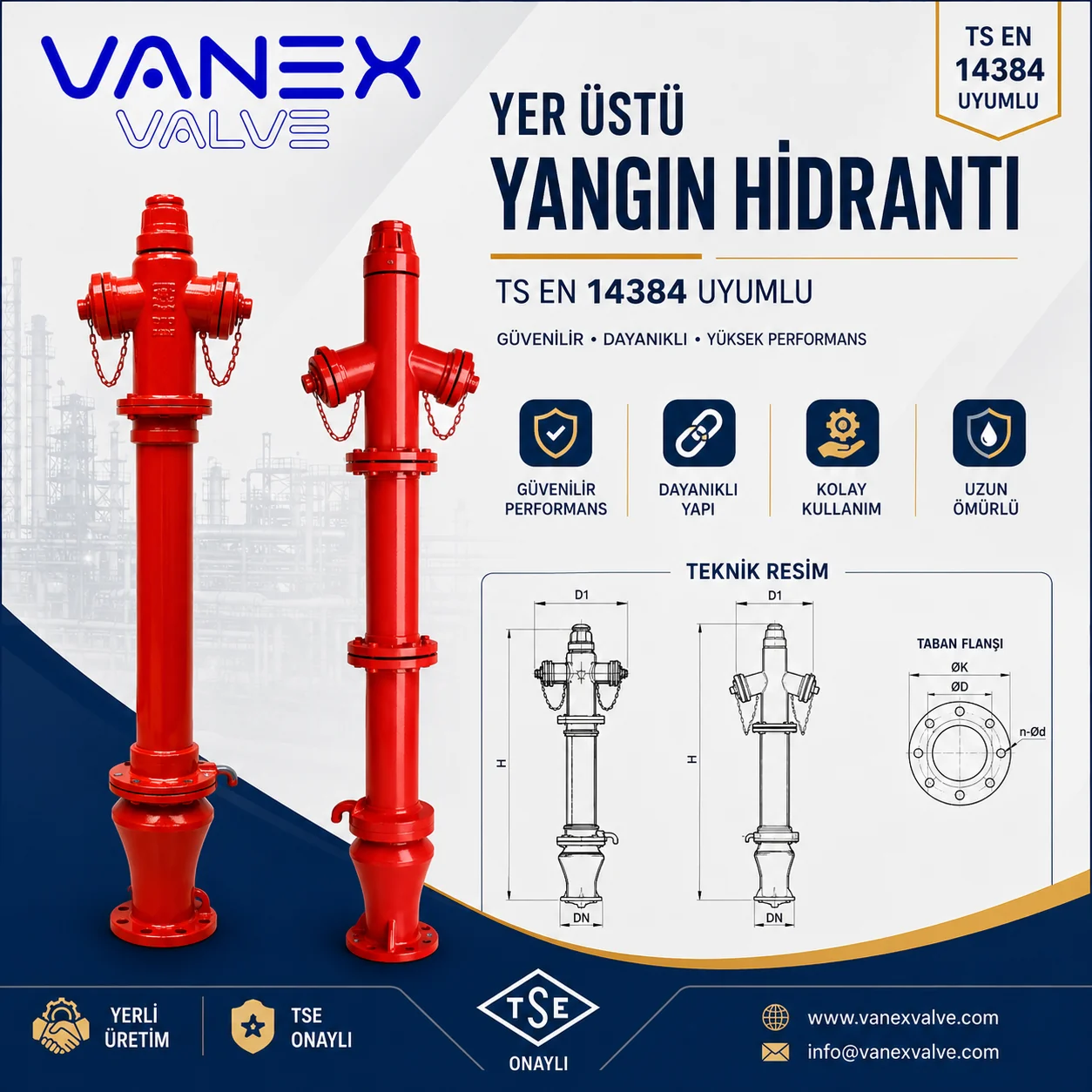
An above-ground fire hydrant is a mechanical equipment connected to a city water network or fire water line, designed to provide high-flow water to fire brigades and fire extinguishing systems during a fire. It is one of the most important components of fire safety in factories, organized industrial zones, warehouses, airports, ports, power plants, shopping centers, and residential areas.
Working Principle
The main function of an above-ground fire hydrant is to safely and quickly transfer pressurized water from the underground fire water line to fire hoses.
Under normal conditions, the hydrant remains completely closed. The main valve blocks the underground water line and prevents water from rising into the hydrant body. In this way, although the system remains under constant pressure, no water is discharged outside.
In the event of a fire, firefighters open the hydrant cap and connect fire hoses to the outlet nozzles. Then, using a hydrant wrench, they turn the operating nut located at the top section.
This movement:
Turns the stem mechanism.
Moves the stem up or down and opens the main valve.
When the main valve opens, pressurized water from the underground line rises into the hydrant body.
The water passes through the body and reaches the outlet nozzles.
Through the hoses, the water is transferred to fire trucks or directly to the fire area.
This process takes place within a few seconds, and the hydrant begins to deliver water at full flow capacity.
How Does It Work in the Closed Position?
In the closed position:
The main valve is completely closed.
Water remains only in the underground main pipeline.
No water enters the hydrant body.
In dry barrel hydrants, the body remains completely empty.
This provides the following advantages:
Prevents freezing.
Reduces corrosion.
Extends the service life of internal parts.
Lowers maintenance costs.
How Does It Work in the Open Position?
When the operator turns the operating nut:
The stem begins to rotate.
The stem lifts the main valve.
Pressurized water from the underground line fills the hydrant body.
The water reaches:
The main body,
The outlet chamber,
The hose connection outlets.
From there, it is transferred to fire hoses.
The water flow rate may vary depending on:
Pipe diameter,
Network pressure,
Hydrant model,
Outlet diameter.
How Does the Drainage System Work?
One of the most important features of dry barrel above-ground hydrants is the drainage system.
When the hydrant is closed:
The main valve closes.
At the same time, the drain valve opens.
The remaining water inside the hydrant body is discharged into the ground through the drain holes located in the lower section.
As a result:
✔ No water remains inside the body.
✔ Freezing is prevented.
✔ Pipe cracking is avoided.
✔ The hydrant can be used safely for many years.
Main Parts of an Above-Ground Fire Hydrant
Body
Top Cap
Operating Nut
Stem
Main Valve
Sealing Gaskets
Nozzle Outlets
Hose Connections
Flange Connection
Drainage System
Protection Cap
All these parts work together to ensure the safe transfer of high-flow water.
Application Areas
Above-ground fire hydrants are used in many areas such as:
Factories
Industrial facilities
Organized industrial zones
Oil and natural gas facilities
Ports
Airports
Municipalities
Hospitals
Universities
Shopping centers
Logistics warehouses
Residential projects
Fire water networks
Advantages
Provides fast response in emergencies.
Offers high-flow water discharge.
Ensures low pressure loss.
Has a long service life.
Allows easy maintenance.
Resistant to outdoor conditions.
Protected against corrosion.
Easily visible.
Allows firefighters to connect quickly.
Maximizes fire safety.
Conclusion
An above-ground fire hydrant is one of the most critical components of fire extinguishing systems. Thanks to its simple yet highly reliable working principle, it transfers pressurized water from underground lines to fire hoses within seconds, allowing rapid response to fires. With regular maintenance, proper installation, and correct hydraulic design, it operates safely and efficiently for many years.