10.07.2026 13:02
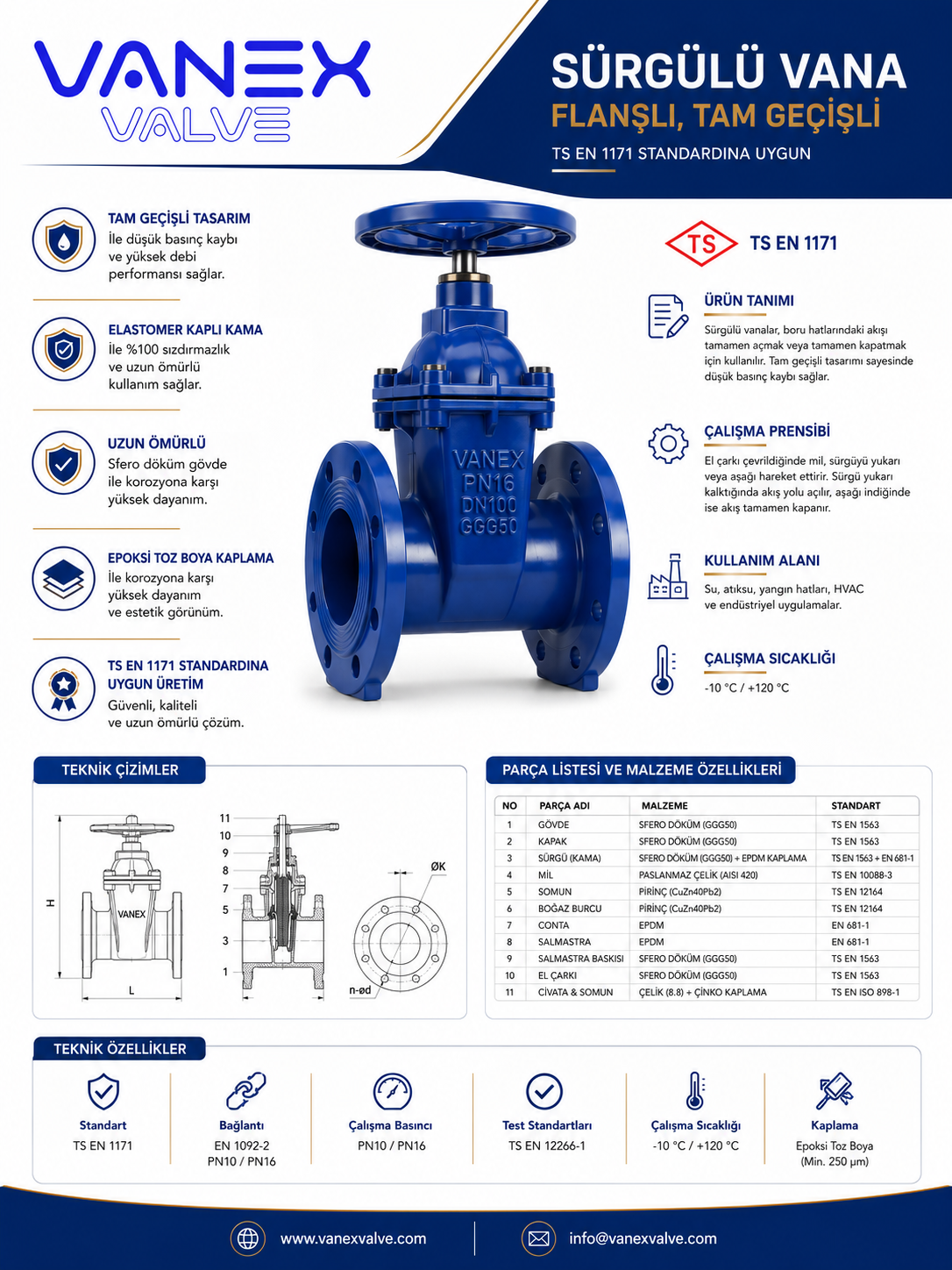
A gate valve is a linear-motion valve used to fully open or completely shut off the flow of liquid or gas in a pipeline. It operates by moving a gate vertically, perpendicular to the direction of flow. When the gate is raised, the flow passage opens. When the gate is lowered onto the valve seats, the passage is closed and the flow stops.
Gate valves are commonly used in water distribution networks, fire protection systems, wastewater plants, industrial facilities, power plants, irrigation systems, natural gas pipelines and various process applications.
Operating Principle
The primary operating components of a gate valve include the handwheel, stem, gate, body, bonnet and sealing surfaces.
When the operator turns the handwheel, rotational movement is transferred to the valve stem. The stem mechanism moves the gate upward or downward inside the valve body.
Open Position
When the handwheel is turned in the opening direction, the stem lifts the gate. Once the gate is completely removed from the flow path, the valve reaches the fully open position.
In the fully open position:
Fluid passes freely through the valve.
The flow passage is approximately equal to the pipe diameter.
Pressure loss is minimized.
Flow turbulence is reduced.
Efficient operation is achieved in high-flow systems.
Full-bore gate valves provide a nearly unrestricted passage and can help reduce pumping energy losses.
Closed Position
When the handwheel is turned in the closing direction, the gate moves downward. The gate contacts the seating surfaces inside the valve body and blocks the flow passage.
In the closed position:
Fluid flow is stopped.
The gate and body seats provide sealing.
Pipeline pressure acts on one side of the gate.
Proper seating materials prevent internal leakage.
Sealing performance depends on the gate design, seat material, pressure, temperature and characteristics of the process fluid.
Main Components
Body
The body is the main pressure-containing part of the valve. Depending on the application, it may be manufactured from cast iron, ductile iron, carbon steel, stainless steel or special alloys.
Gate
The gate is the moving element that opens or closes the flow passage. It may have a wedge-shaped, parallel, metal-seated or resilient-seated design.
Stem
The stem transfers the motion of the handwheel or actuator to the gate. It is generally manufactured from stainless steel or another high-strength material.
Handwheel
The handwheel is used for manual operation. Gear operators may be used on large-diameter or high-pressure gate valves.
Bonnet
The bonnet closes the upper part of the valve body and supports the stem mechanism. It may be bolted, threaded, welded or pressure-sealed.
Sealing Elements
Seats, packing and gaskets prevent leakage through the body, gate, bonnet and stem areas. Common materials include elastomers, graphite, PTFE and metallic alloys.
Rising Stem Gate Valve
In a rising stem gate valve, the stem moves upward as the valve opens and downward as it closes. The visible stem position allows operators to identify whether the valve is open or closed.
Rising stem gate valves are commonly used in fire protection and industrial applications where visual position indication is important. Sufficient vertical installation space must be provided above the valve.
Non-Rising Stem Gate Valve
In a non-rising stem design, the stem rotates without moving vertically outside the valve body. Internal threads move the gate upward or downward.
This design:
Requires less installation space.
Is suitable for underground applications.
Maintains a constant overall height.
Provides a compact configuration.
A separate position indicator may be required to show whether the valve is open or closed.
Resilient-Seated Gate Valve
In a resilient-seated gate valve, the gate is fully or partially coated with an elastic material such as EPDM. When the valve closes, the resilient surface compresses against the valve body seat and provides tight shut-off.
These valves are widely used in:
Drinking-water networks
Municipal water systems
Fire protection lines
Irrigation systems
Water-treatment plants
The resilient coating can accommodate small particles and usually allows operation with lower torque.
Metal-Seated Gate Valve
Metal-seated gate valves use metallic contact surfaces between the gate and the body seats. They are suitable for high temperatures, abrasive fluids and services where elastomeric materials cannot be used.
Metal-seated valves offer high mechanical resistance but may require greater operating torque than resilient-seated designs.
Can a Gate Valve Be Used for Flow Regulation?
Gate valves are primarily designed for fully open or fully closed service. Continuous operation in a partially open position is not recommended.
When the valve remains partially open:
Flow velocity increases through the restricted area.
The gate and seating surfaces may erode.
Vibration and noise may occur.
Cavitation risk may increase.
Sealing surfaces may become damaged.
Valve service life may be reduced.
Globe valves, butterfly valves or dedicated control valves should be used when accurate flow regulation is required.
Advantages
Low pressure loss in the fully open position
Suitability for large pipe diameters
Availability of bidirectional designs
High flow capacity
Long service life with proper material selection
Compatibility with manual, electric, pneumatic and hydraulic actuators
Availability for both underground and above-ground installations
Operation and Maintenance
Excessive force should not be applied to the handwheel. Continuing to force the valve after it reaches the fully open or fully closed position may damage the stem, gate or seating surfaces.
During maintenance:
Inspect the stem and moving components.
Check the packing and gaskets for leakage.
Inspect bolted connections.
Remove corrosion from external surfaces.
Fully cycle the valve periodically.
Check actuator torque settings on automated valves.
A correctly selected and properly maintained gate valve provides reliable, efficient and long-lasting isolation in pipeline systems.